
When to Use Utility Templates
Use Utility templates whenever you are sending a message in response to something the customer or your team has just done:
A new booking has just been made → send Order confirmation
Your driver could not reach the customer for pickup → send Pick up failed
The customer's items are clean and ready → send Ready for collection or Delivery complete
An invoice has been generated → send Order invoice
The customer has paid → send Order receipt
An order needs to be cancelled → send Order cancelled
Pre-Built Templates Available
EasyBiz provides 13 ready-made Utility templates so you do not have to start from scratch. Each one is already written in the correct Utility style.
| Template | What it sends | Pre-built buttons |
|---|---|---|
| Welcome | New account created confirmation | None |
| Order confirmation | Booking confirmed with pickup and delivery details | Track order |
| Pick up failed | Pickup attempt unsuccessful | Reschedule, Call us |
| Pick up rescheduled | Pickup time has been changed | None |
| Pick up complete | Items have been collected | Track order |
| Delivery failed | Delivery attempt unsuccessful | Reschedule, Call us |
| Delivery rescheduled | Delivery time has been changed | None |
| Delivery complete | Order has been delivered | Call us |
| Ready for collection | Order ready for store pickup with address | Directions |
| Collected | Customer collected their order | None |
| Order invoice | Invoice available with amount due | Make payment |
| Order receipt | Payment received with PDF receipt | None |
| Order cancelled | Order successfully cancelled | View order detail |
Creating a Utility Template
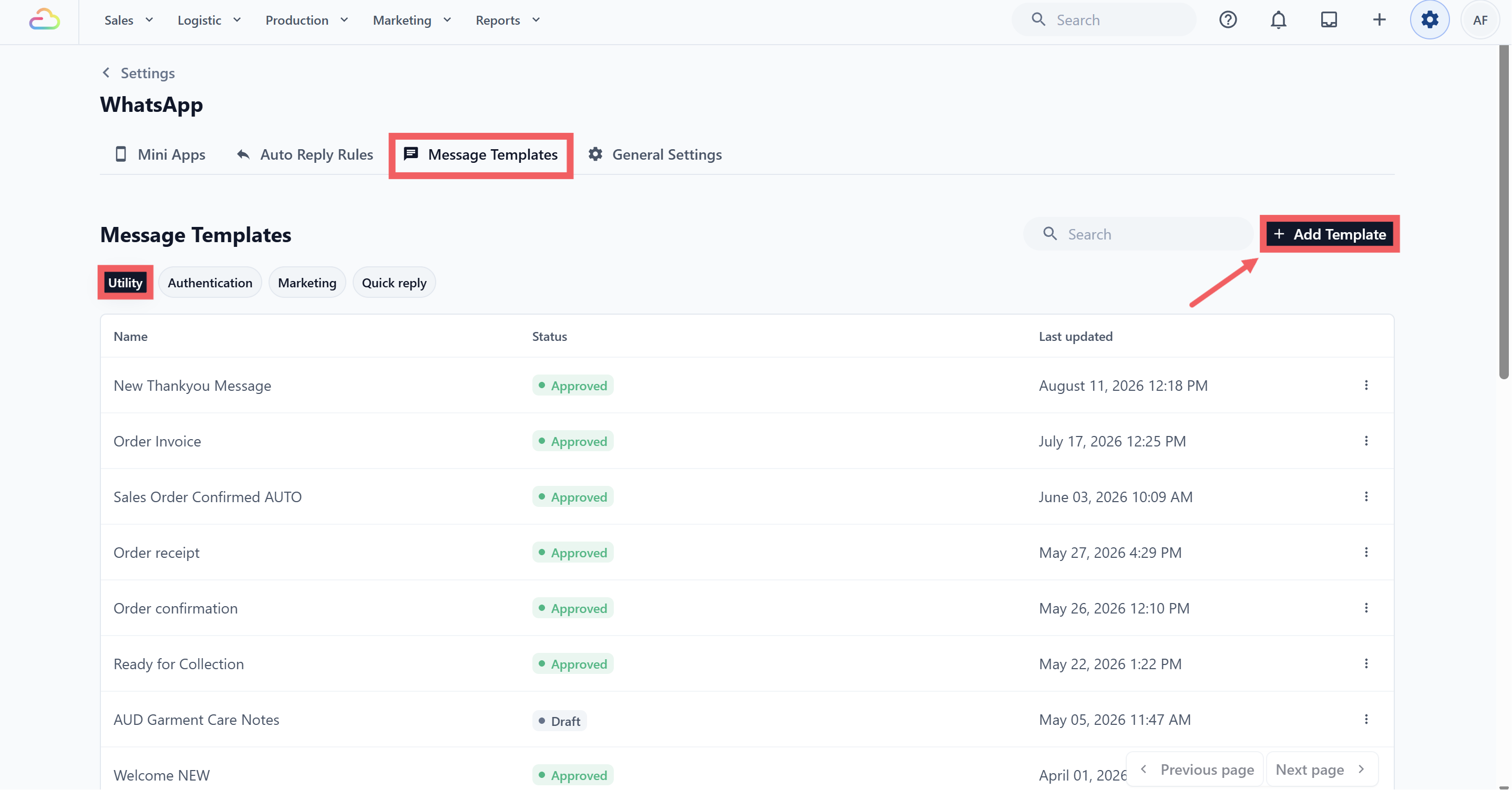
- Click the Utility tab then click + Add Template, a dialog titled "New WhatsApp Template" will appear.
- Fill in the template details:
Template name — An internal label for your team (e.g. Order Confirmed, Collection Ready). Not shown to customers.
Auto-move deal to stage — Optional. Automatically moves the customer to a stage in your sales pipeline when this template is sent. Leave as None if you are not using Deals. Learn more about Deals
Default reply status
Replied — Marks the conversation as done and removes it from your Pending list.
Pending — Keeps it in your Pending list so your team remembers to follow up.
Click a pre-built template card to select it. A blue border appears around the selected card. The Create button is greyed out until you have selected one. Click Create and the editor will open with the template pre-loaded and ready for you to customize.
Click Create to open the template editor
Configuring the Template in the Editor
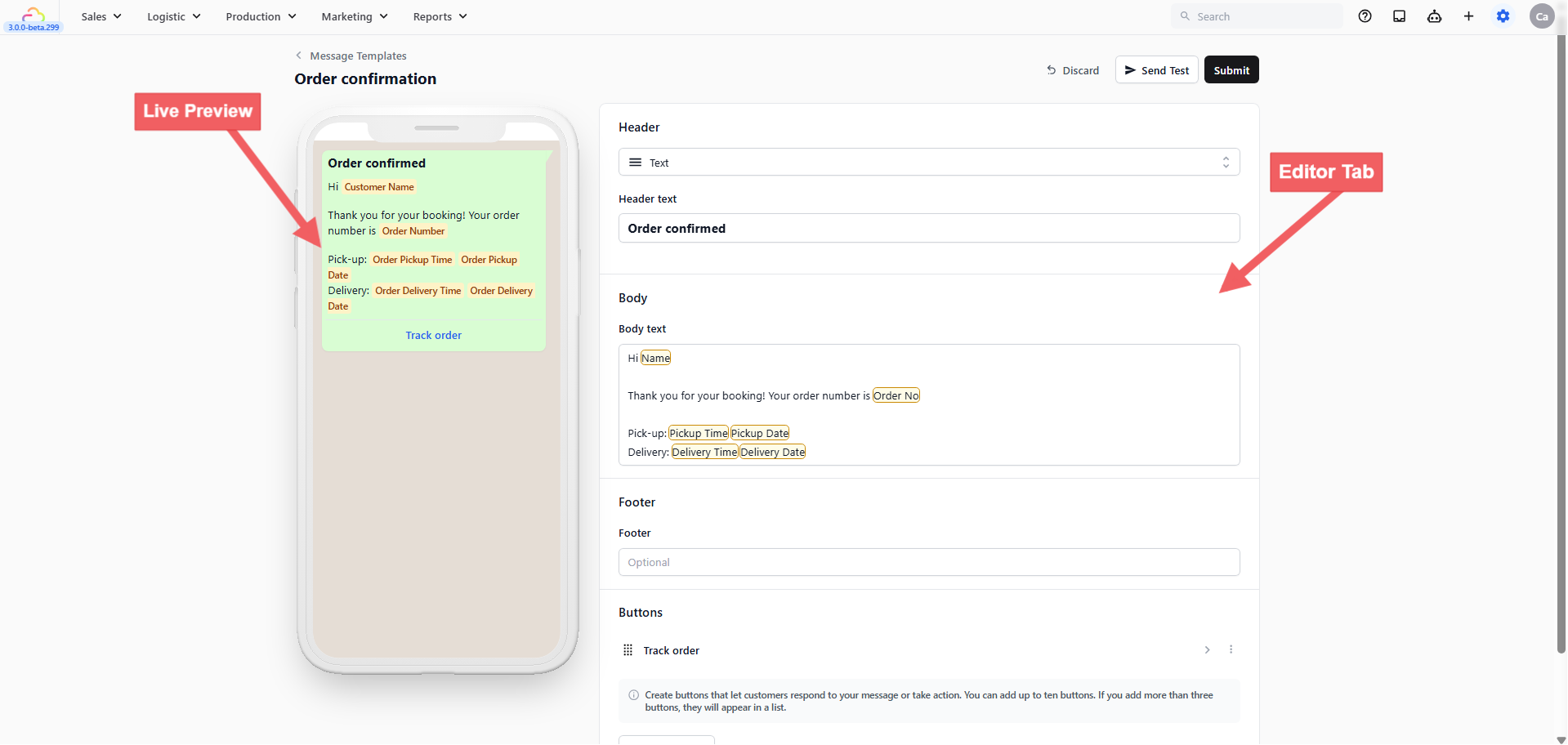
The editor shows a live preview on the left that updates as you type. Configure the template using the sections on the right:
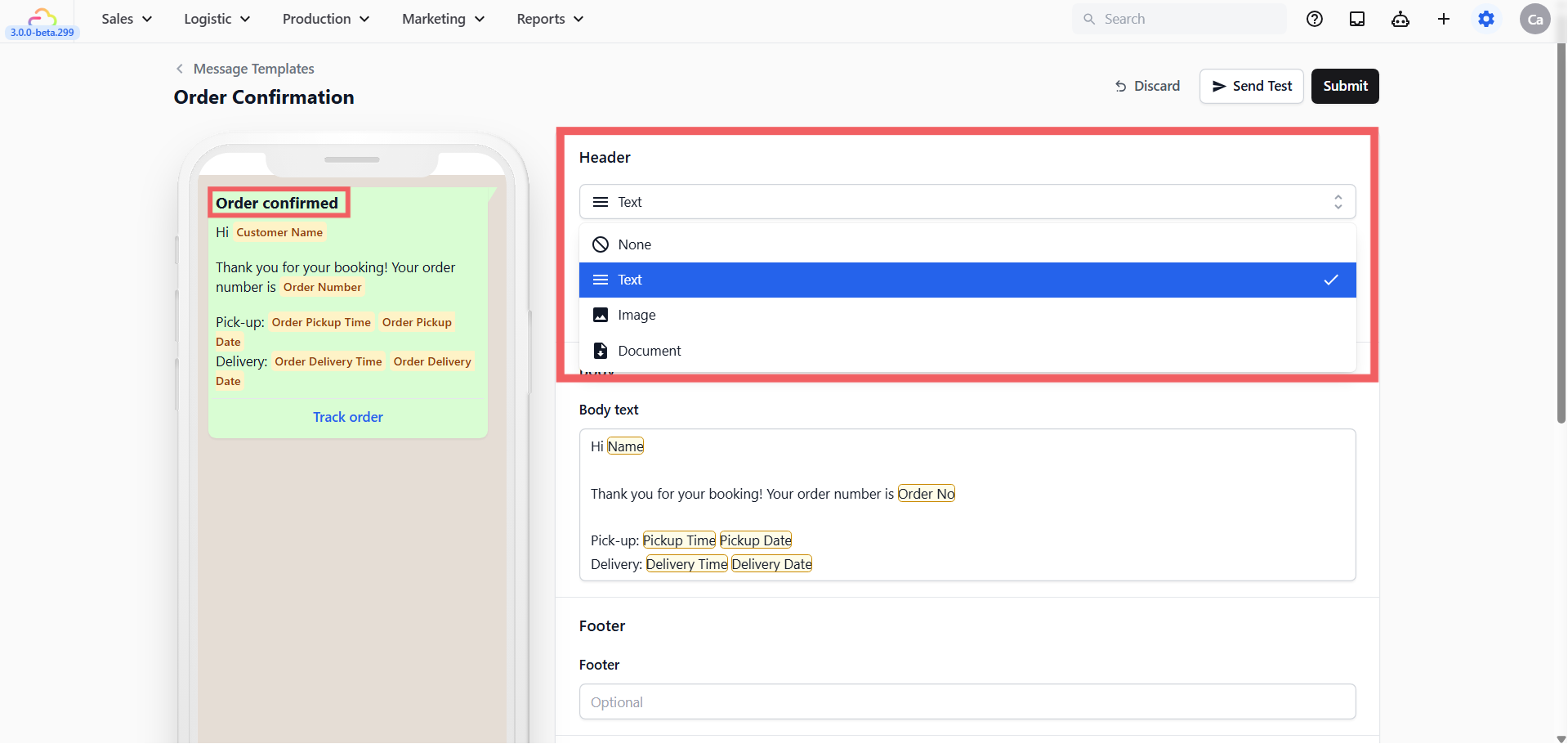
Header
Appears at the very top of the message. Options:
None — No header
Text — A short bold title (e.g. Your Order Is Confirmed!)
Image — A photo or banner
Document — A PDF attachment
Body
The main message your customer reads. Keep it short and factual.
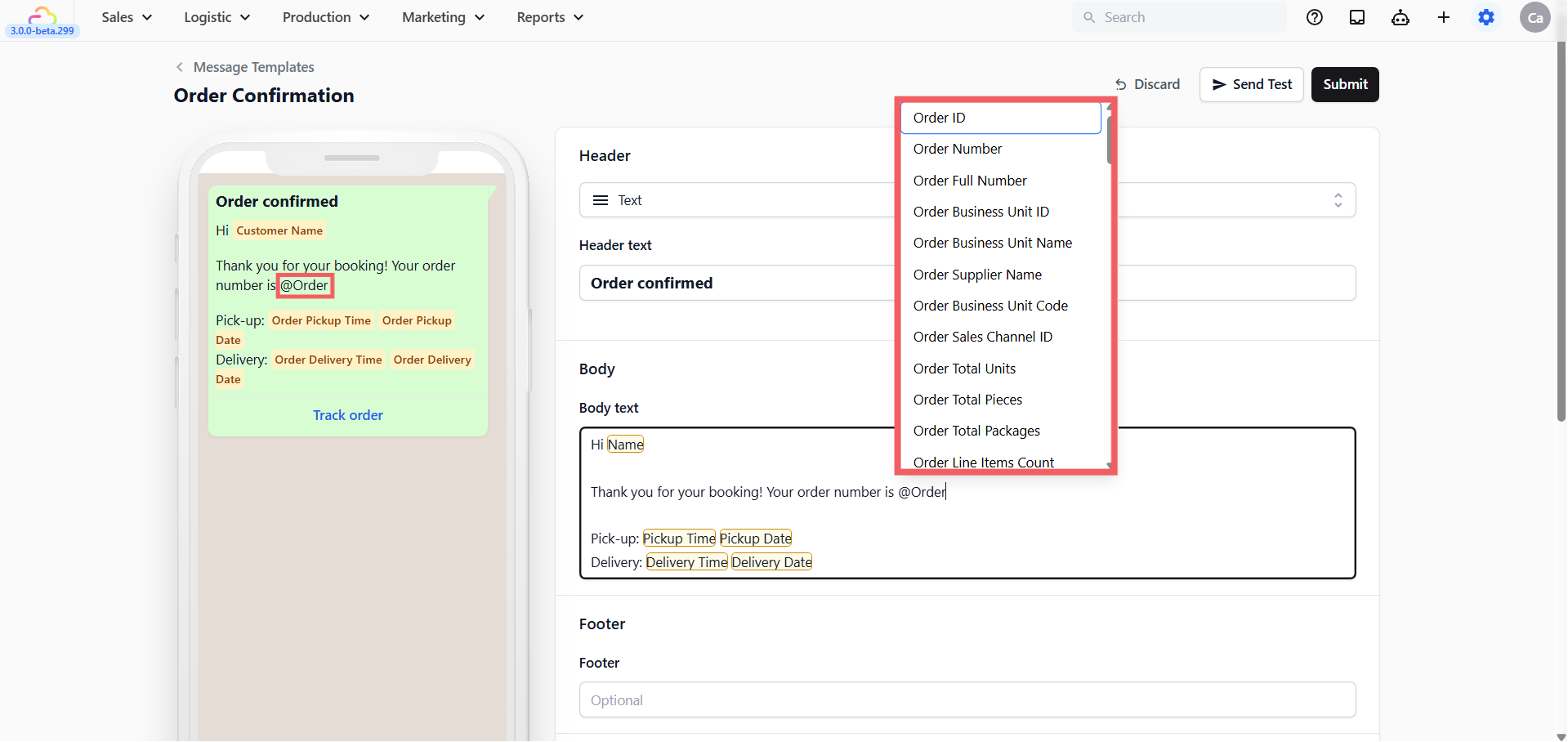
To personalise the message, type @ in the Body field and a dropdown list of available placeholders will appear, Click any one to insert it into your message. EasyBiz fills these in automatically with real information when the message is sent. Some commonly used placeholders:
@Customer Name— e.g. Sarah@Order Number— e.g. #00234@Order Pickup Date— e.g. Wednesday, 9 April@Order Pickup Time— e.g. 10:00 AM – 12:00 PM@Order Delivery Date— e.g. Friday, 11 April@Order Delivery Time— e.g. 2:00 PM – 5:00 PM@Order Amount Due— e.g. SGD 45.00
These are just the most commonly used ones. The system has many more available — customer email, customer phone, store name, order date, order subtotal, and more. Type @ in the Body field to see the full list and pick exactly what you need.
Footer
A short closing line below the body. Use it for your business name or a brief note. Cannot contain placeholders.
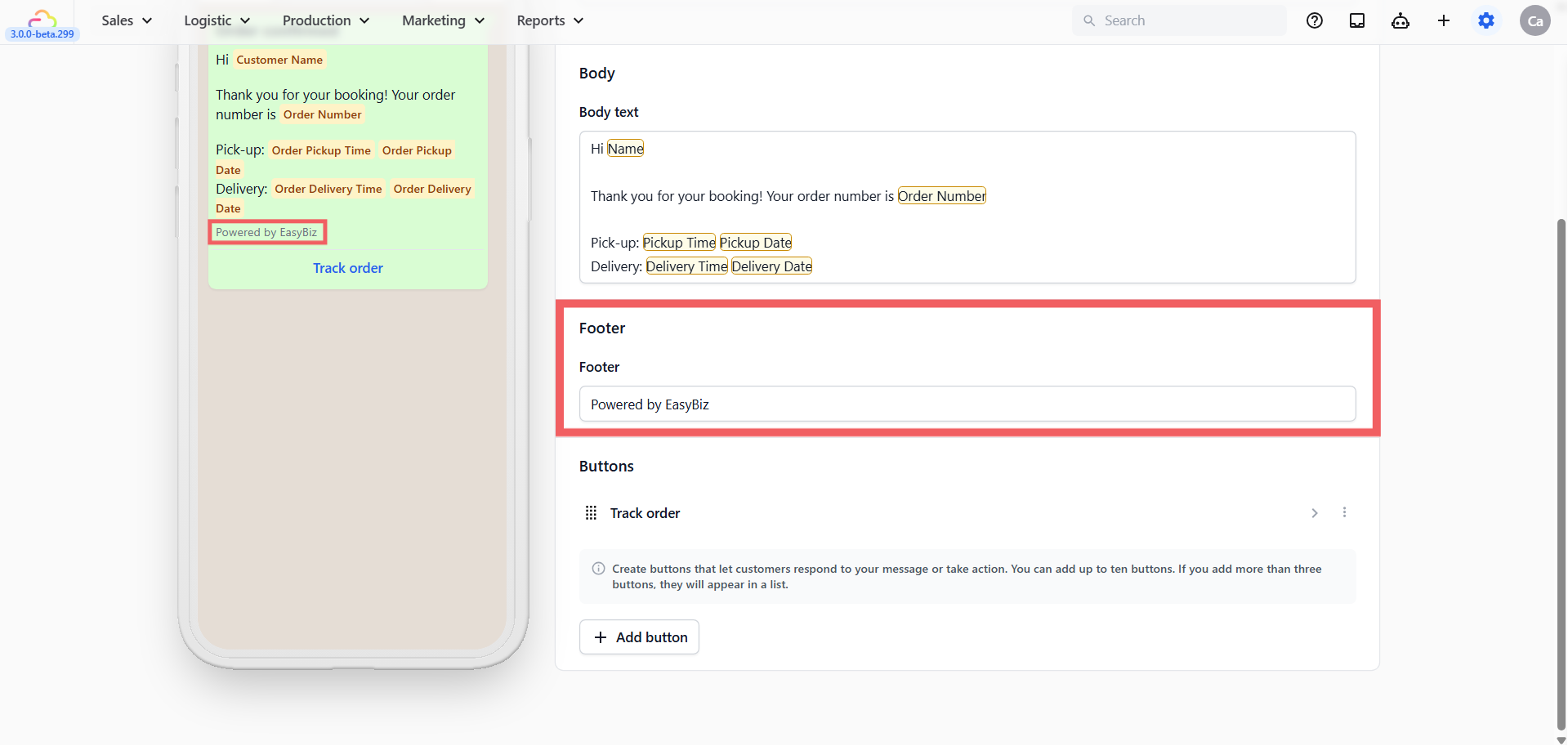
Buttons
Buttons appear below the message as tappable links. Click + Add button and choose:
Quick reply → A tappable reply button the customer can tap (e.g. "Yes, I'm interested", "Stop Promotion").
Visit website → Opens a webpage. Choose Static (same URL for everyone) or Dynamic (URL changes per customer). For most businesses, Static is all you need.
Call phone number → Dials a number you enter.
Open Mini App → Opens a booking or order form inside WhatsApp. Select which Mini App to link. Learn more about Mini Apps
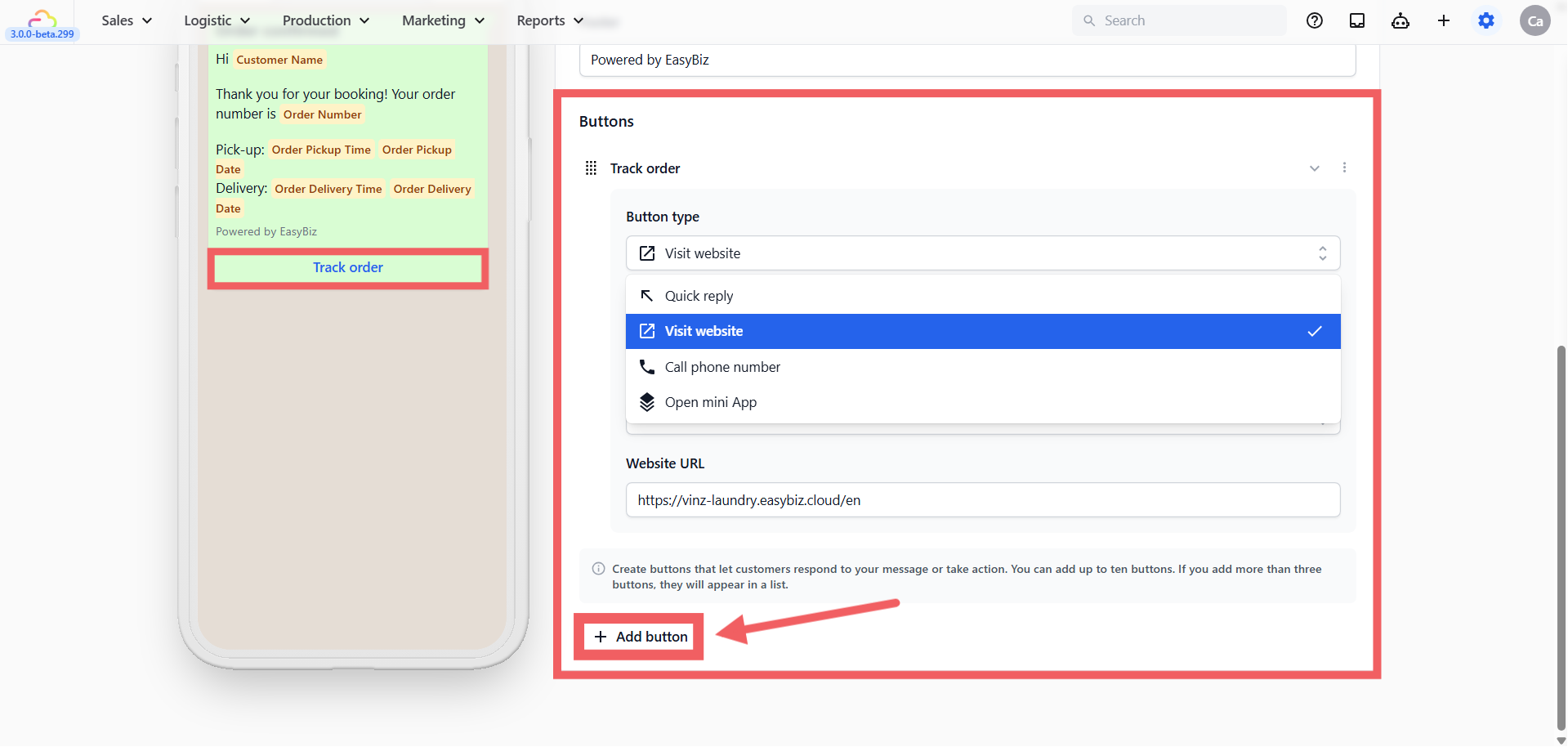
You can add up to 10 buttons. If you add more than 3, they automatically appear as a scrollable list. Drag and drop to reorder.
Submitting for Approval
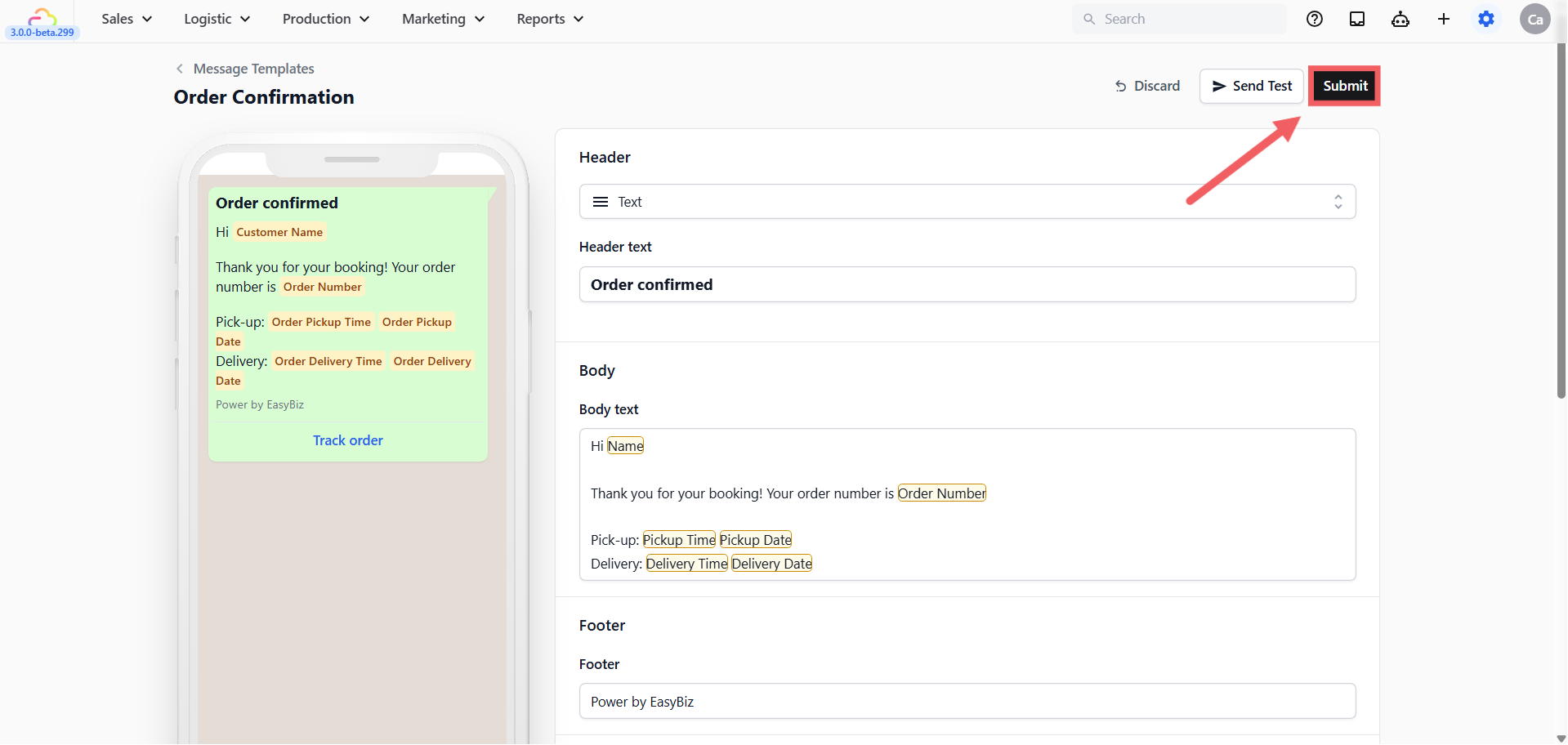
When you are happy with your template, click Submit at the top right.
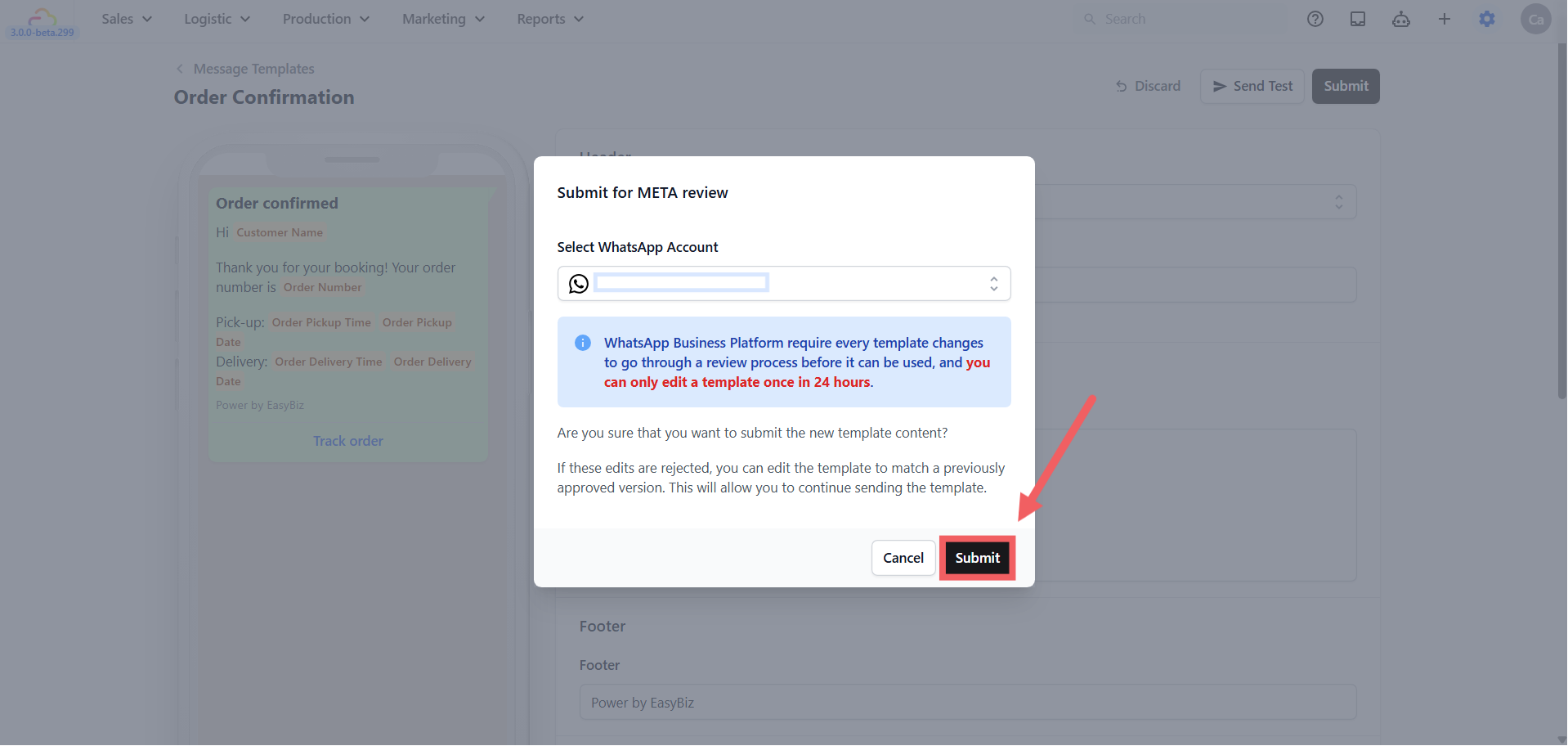
Select your WhatsApp Business Account and click Submit. Meta review usually takes a few minutes but can take up to 24 hours.
After submitting, you can return to the template list where the status will show as Pending. Once Meta approves it, the status will change to Approved and the template is ready to send to customers.
How to Send Your Utility Template
Once your template is approved, there are two ways to send it.
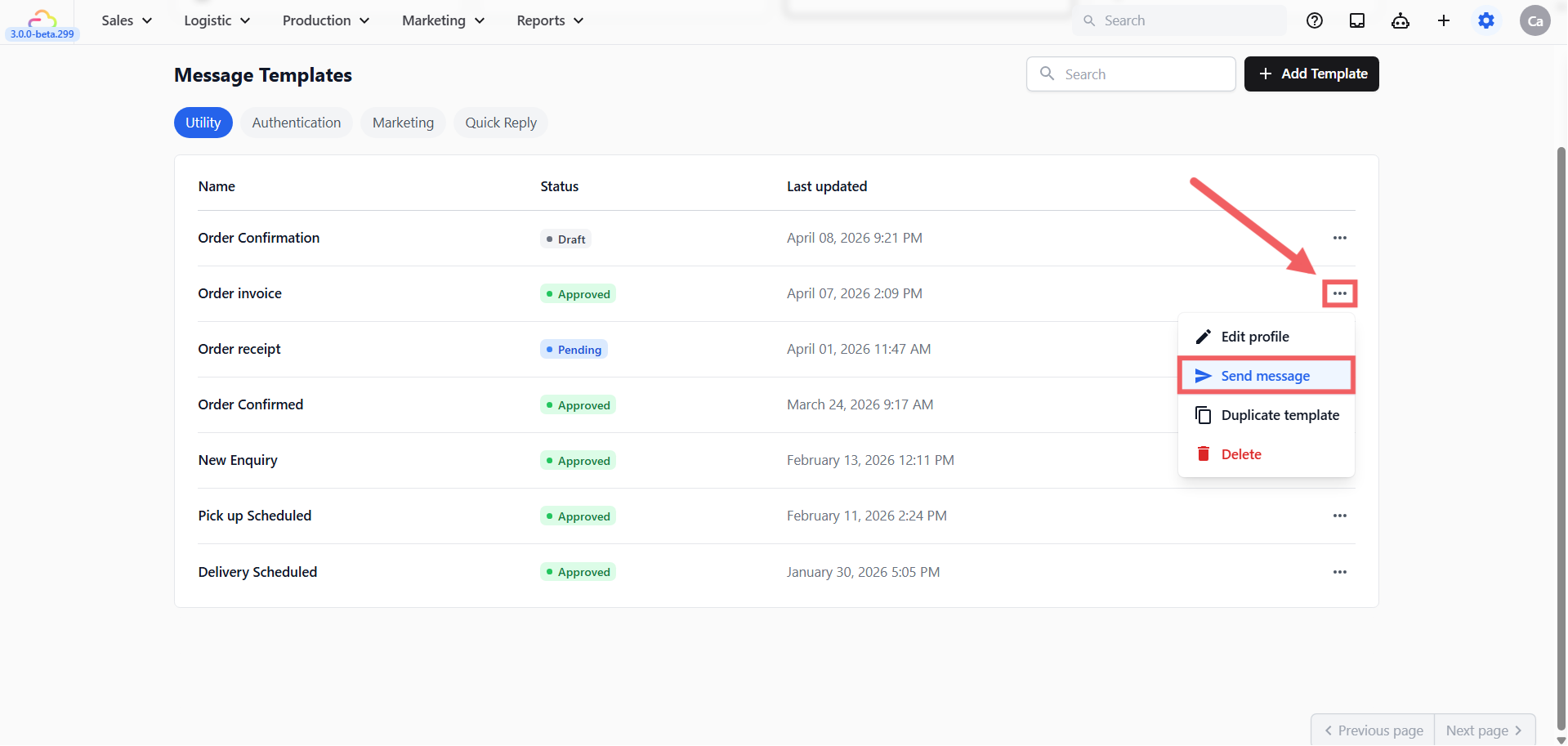
Send directly from the template list
Go to the Message Templates page and click the Utility tab
Find the template you want to send
Click the ⋮ three-dot menu on the right of that template row
Click Send message and a dialog will appear
If your template contains placeholders like
@Customer Nameor@Order Number, EasyBiz will ask you to confirm the details before sending. Templates with no placeholders will send immediately.Click Send
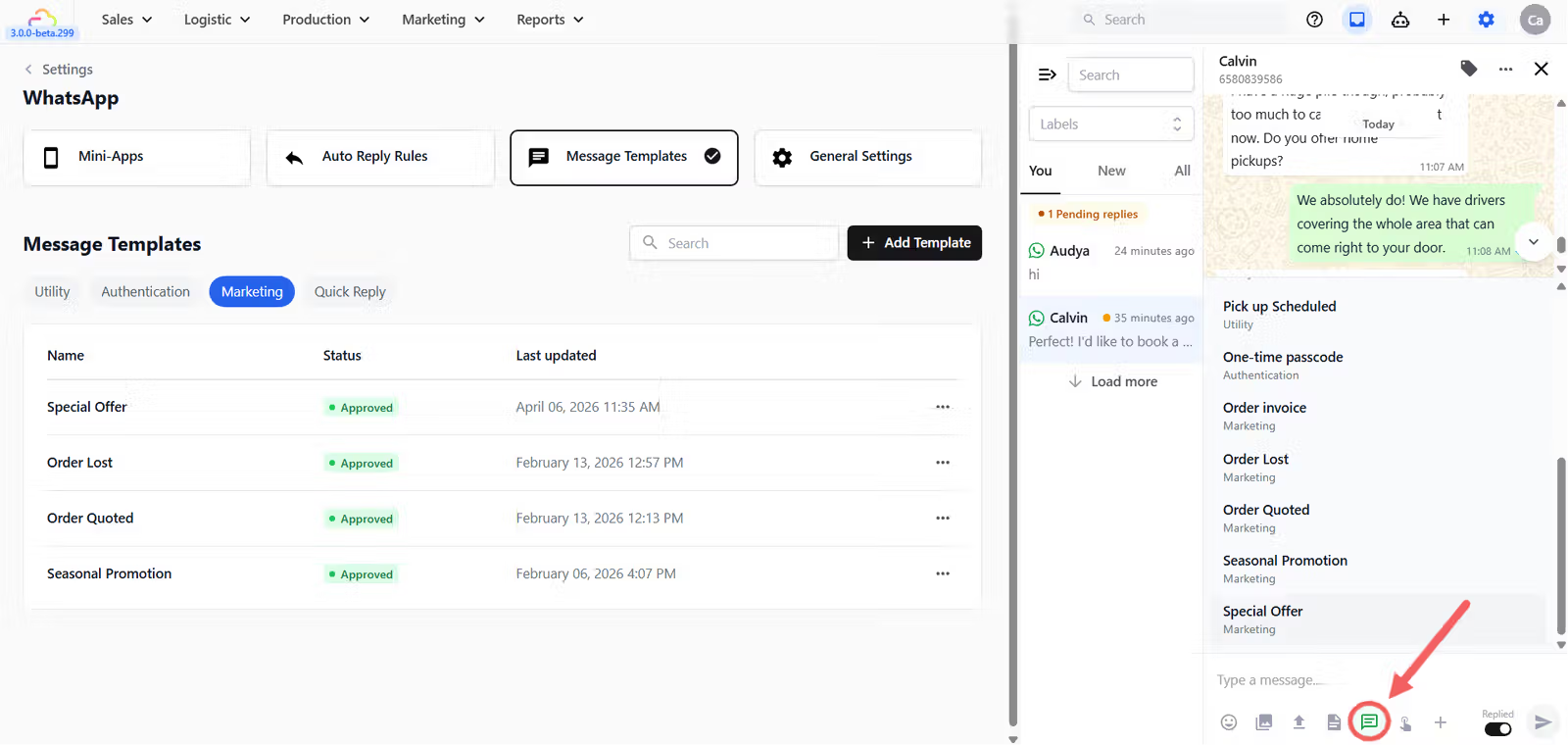
Send from the inbox
Open your WhatsApp Inbox and select the customer
Below the typing area, click the Template icon (it looks like a message bubble 💬)
Select your approved Utility template
If your template contains placeholders like
@Customer Nameor@Order Number, EasyBiz will ask you to confirm the details before sending. Templates with no placeholders will send immediately.Click Send
Keeping Your Templates in the Utility Category
If customers suddenly stop receiving your messages — don't panic. This is likely Error 131049, WhatsApp's way of flagging messages that too many recipients are ignoring. Utility templates are far less likely to trigger this block because they respond to real customer actions, not unsolicited outreach.
If you see Error 131049, stop using that template. Create a new one as Utility, follow these tips, and resubmit:
Tie every message to a specific customer action. "Your order #1234 is confirmed" is Utility. "Don't forget to book again!" is Marketing.
No promotional content anywhere — not even one line. Adding "Enjoy 10% off your next visit!" to a receipt moves the entire template to Marketing.
Be specific, not generic. Vague messages with no order details or context are automatically classed as Marketing.
Avoid open-ended questions. "Let us know if you need help" or "Any questions?" signal engagement intent to Meta's system.
Write like a system notification. Order number, status, date, amount. Just the facts.
What's Next?
Now that your utility templates are ready, continue to Setting Up Marketing Templates to create promotional messages you can send to opted-in customers.